Many companies believe that receiving a strong quotation or visiting a factory once is enough to confirm a supplier is reliable. In Southeast Asia’s diverse manufacturing landscape, that assumption can create serious risk. Legal structure, financial stability, compliance standards, and operational capacity are not always visible at first glance.
We conduct supplier due diligence across the region every day. We have seen how overlooked warning signs can lead to delays, quality failures, or contract disputes months later. Proper validation requires a structured process, not a quick check.
This article explains how companies conduct supplier due diligence in Southeast Asia, outlining the 5 step-by-step approach to background checks, financial vetting, compliance screening, and on-site verification.

What Supplier Due Diligence Actually Means in Practice
Supplier due diligence is often confused with supplier selection. They are not the same. Selection focuses on price, samples, and basic capability. Due diligence goes deeper. It asks whether the supplier is legally sound, financially stable, operationally capable, and compliant over time.
In Southeast Asia, that distinction plays a key role. Regulations vary. Enforcement levels differ by country and even by province. A factory that looks credible online may still carry hidden risks.
Core Objectives of Structured Due Diligence
A proper due diligence process typically aims to:
- Confirm the supplier is a legitimate, registered legal entity
- Verify ownership and management structure
- Assess financial health and exposure
- Validate compliance with labor, environmental, and export regulations
- Confirm operational capacity matches production claims
Why Regional Nuance Matters
In our experience, supplier maturity can differ widely across ASEAN markets. Infrastructure quality, documentation standards, and transparency levels vary. That is why due diligence cannot rely on a single checklist copied from another region.
For companies prioritizing ethical sourcing and sustainability in modern procurement, compliance screening becomes a core element of supplier validation, not an optional add-on. Environmental permits, worker safety systems, and waste management practices must be assessed beyond written policies.
Step 1 – Legal and Corporate Background Checks
Before discussing pricing or production schedules, companies should confirm that the supplier legally exists and is authorized to operate. It sounds obvious. Yet this step is often rushed.
In Southeast Asia, business registration structures differ by country. Some suppliers operate through holding companies. Others use trading arms separate from their manufacturing entity. Clarifying who you are contracting with is essential.

Verifying Legal Status
A structured legal review typically includes:
- Confirming company registration with the appropriate national authority
- Validating export licenses and manufacturing permits
- Reviewing shareholder and director information
- Checking whether the factory address matches official records
Mismatched names, recently formed entities claiming large capacity, or unclear ownership structures are signals worth investigating further.
Reputation and Regulatory Screening
Legal existence alone is not enough. Companies also screen for:
- Sanctions exposure
- Past regulatory violations
- Litigation history
- Environmental or labor-related fines
In some cases, these issues are not disqualifying. But they require transparency and explanation.
Why This Step Cannot Be Skipped
When this stage is overlooked, buyers may discover too late that they contracted with the wrong legal entity or that permits were incomplete. Resolving such issues after production has started is significantly more difficult.
Step 2 – Financial Stability Assessment
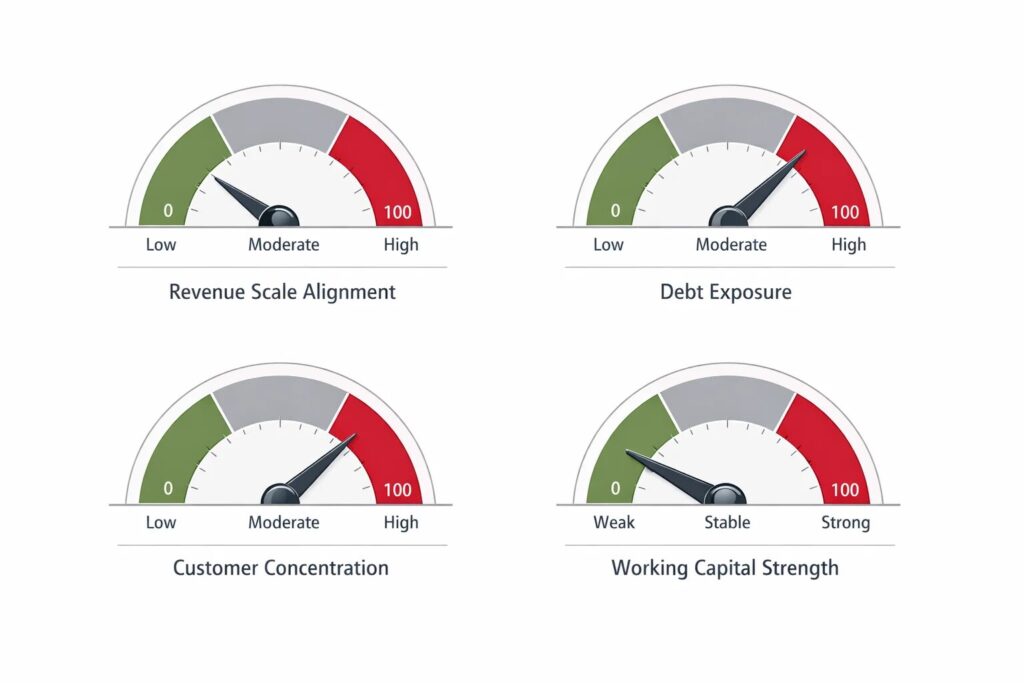
A supplier may look operationally strong but still carry financial risk. In Southeast Asia, many manufacturers operate on tight margins. A sudden cash flow issue can disrupt production, delay shipments, or lead to subcontracting without disclosure.
Key Indicators Buyers Review
A structured financial review often looks at:
- Reported revenue compared to claimed production scale
- Customer concentration risk
- Debt levels relative to assets
- Working capital sufficiency
If a factory claims large export volumes but reports modest turnover, that discrepancy deserves clarification.
Why Financial Health Directly Affects Supply Stability
Financially strained suppliers may:
- Request advance payments earlier than agreed
- Delay procurement of raw materials
- Cut corners on quality control
- Struggle to absorb sudden order increases
When to Deepen the Review
Additional scrutiny is often warranted when:
- A supplier has expanded rapidly in a short period
- Major new equipment has been financed through debt
- The business relies heavily on one overseas customer
Step 3 – Compliance and ESG Screening
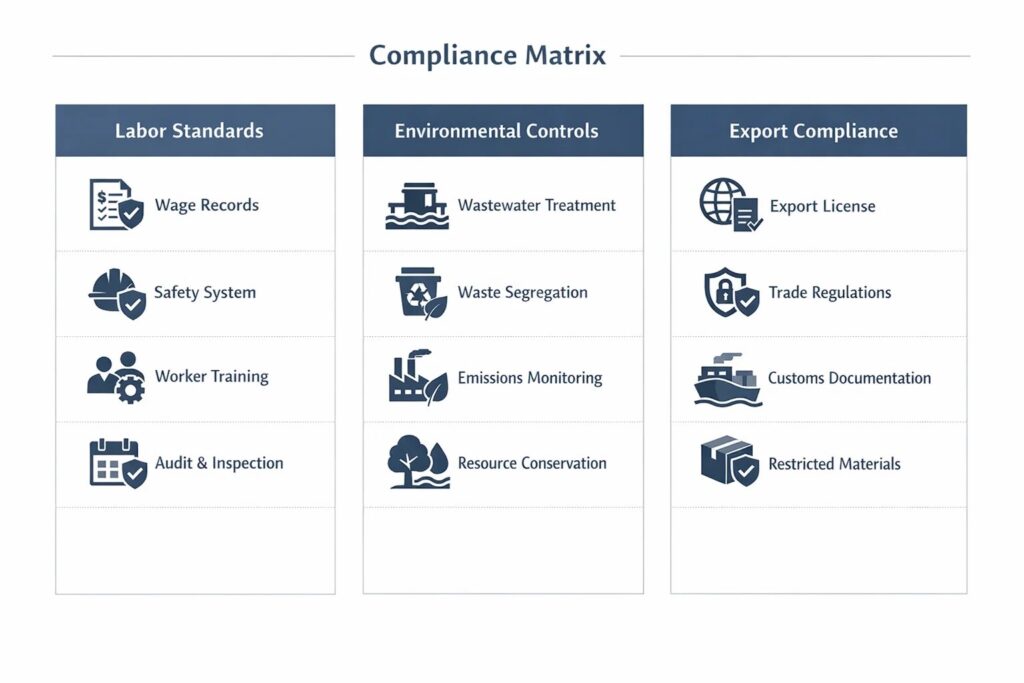
Compliance is no longer limited to basic legal requirements. Buyers increasingly evaluate suppliers against labor standards, environmental controls, and broader ESG expectations. In Southeast Asia, this layer of due diligence has become central to supplier approval.
Regulatory Compliance Checks
At a minimum, companies verify that suppliers comply with local regulations, including:
- Labor laws covering wages, working hours, and contracts
- Environmental permits for emissions, wastewater, and waste disposal
- Valid export documentation and customs registrations
ESG Practices Beyond Documentation
This is where screening deepens. Buyers review:
- Worker health and safety systems
- Waste management and pollution controls
- Emergency preparedness procedures
- Internal compliance monitoring processes
Industry-Specific Considerations
Different industries carry different risks. Apparel production often raises labor-related concerns. Electronics manufacturing may require closer review of chemical handling and environmental controls. Automotive and industrial production demand strict safety and traceability systems.
Step 4 – Operational Capability Verification
Legal registration and compliance documents can look strong on paper. The real question is whether the factory can consistently deliver what it promises.
Operational due diligence focuses on capacity, systems, and execution.
Validating Production Capacity
Capacity claims are often optimistic. Buyers need to confirm whether output targets align with actual equipment and workforce levels.
Verification typically includes:
- Reviewing machinery count and condition
- Comparing equipment type to product requirements
- Assessing number of production lines and shift structures
- Evaluating workforce size relative to projected output

Quality Control and Process Systems
Consistent production depends on structured quality management. Buyers often assess:
- Incoming material inspection procedures
- In-line quality checkpoints
- Final inspection protocols
Traceability and batch tracking systems
Well-documented quality systems reduce defect rates and protect long-term relationships.
For companies seeking to strengthen oversight, the principles behind optimizing supplier audits to ensure standards compliance become especially relevant. Structured audits are not just about finding issues. They confirm whether systems are functioning as intended.

Supply Chain Depth and Subcontracting Risk
Another critical factor is whether the supplier relies on undisclosed subcontractors. Hidden subcontracting introduces quality and compliance risk.
Operational verification often includes:
- Identifying tier-two suppliers
- Confirming raw material sourcing stability
- Checking whether overflow production is outsourced
Step 5 – On-Site Verification and Risk Assessment
Documents tell part of the story. Site visits tell the rest.
In Southeast Asia, on-site verification remains one of the most effective ways to validate supplier claims. It confirms whether operations, compliance, and capacity align with what has been presented remotely.
What Buyers Look For During a Factory Visit
An on-site assessment typically includes:
- Confirming the factory physically exists and matches the registered address
- Observing active production lines in operation
- Reviewing warehouse organization and inventory management
- Inspecting safety systems and emergency preparedness
Where Buyers Must Exercise Caution
Incentives are rarely unconditional. Eligibility often depends on:
- Minimum investment thresholds
- Export ratios
- Industry classification
- Compliance with ongoing reporting requirements
Small inconsistencies often reveal larger issues. Equipment that appears underutilized. Production floors that do not match declared output. Temporary setups presented as permanent capacity.
Management Transparency and Responsiveness
A site visit is also a test of transparency. Buyers evaluate how management responds to detailed questions and whether documentation is readily available.
Warning signs may include:
- Reluctance to allow access to certain areas
- Vague answers about subcontracting
- Incomplete or outdated compliance records
Assessing Cultural and Communication Fit
Due diligence is not only technical. Communication style, responsiveness, and problem-solving approach matter. Suppliers that engage constructively during verification tend to handle production challenges more effectively later.
Turning Supplier Due Diligence into a Competitive Advantage
Supplier due diligence in Southeast Asia is not about distrust. It is about clarity. Legal verification, financial screening, compliance checks, operational validation, and on-site assessment together create a structured view of risk before production begins.
From our experience at Source One, the companies that invest in thorough due diligence avoid the most costly sourcing mistakes. They identify gaps early, negotiate from a stronger position, and build supplier relationships based on verified capability rather than assumptions. Reliable due diligence is not a delay to sourcing. It is a safeguard that protects cost, timelines, and brand reputation.
When conducted systematically and monitored continuously, supplier validation becomes a strategic tool. It strengthens supply chain resilience and supports long-term sourcing success across Southeast Asia.
What Procurement Leaders Should Never Overlook
- Legal verification is the foundation of every supplier relationship
- Financial instability can disrupt production even when operations look strong
- Compliance must be assessed beyond written policies
- On-site verification reveals what documents cannot
- Hidden subcontracting introduces avoidable risk
- Ongoing monitoring is as important as initial screening
- Structured due diligence reduces surprises and protects margins